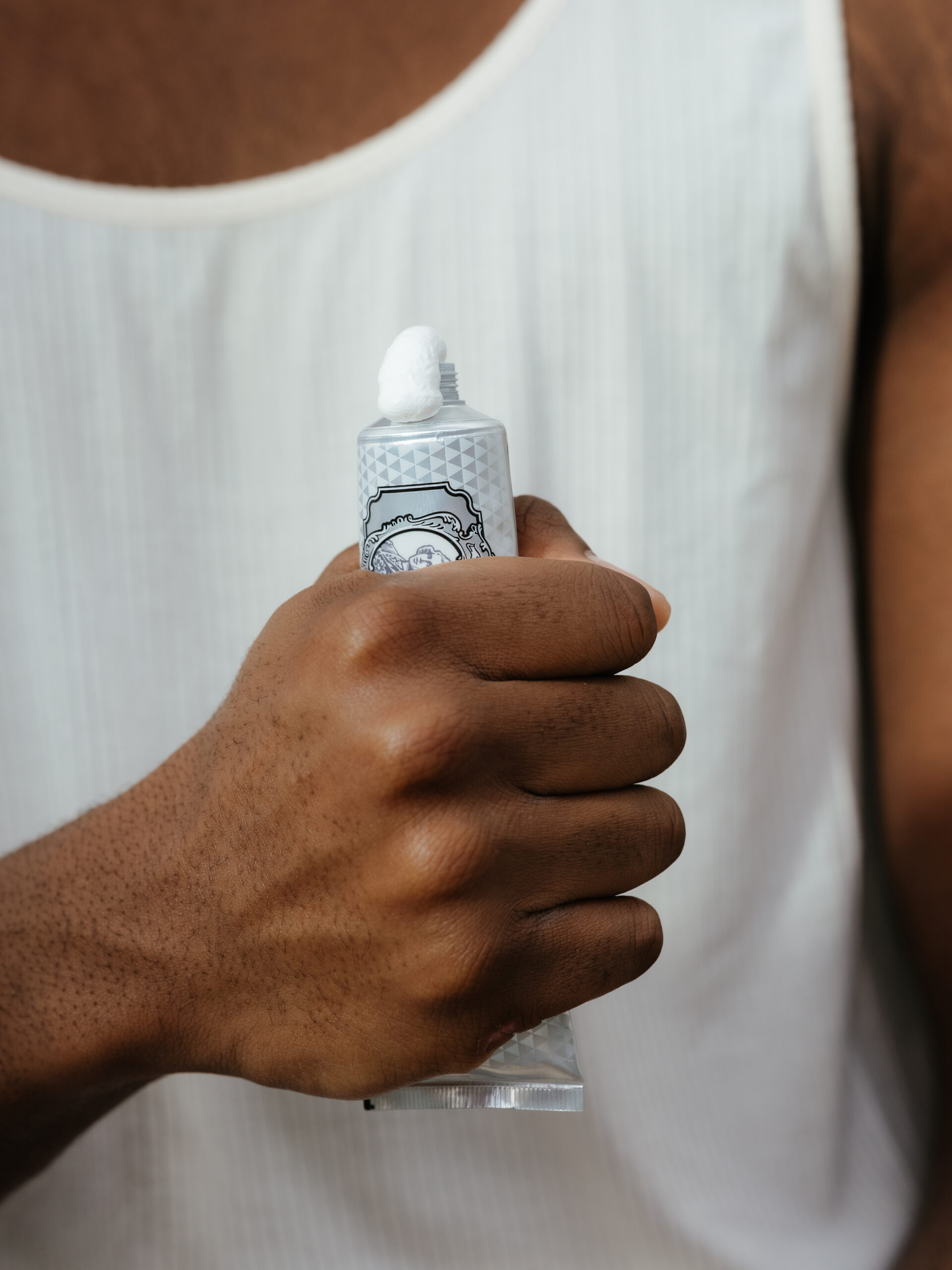
Metal-free, well tolerated, and as close to your own tooth as it gets today.
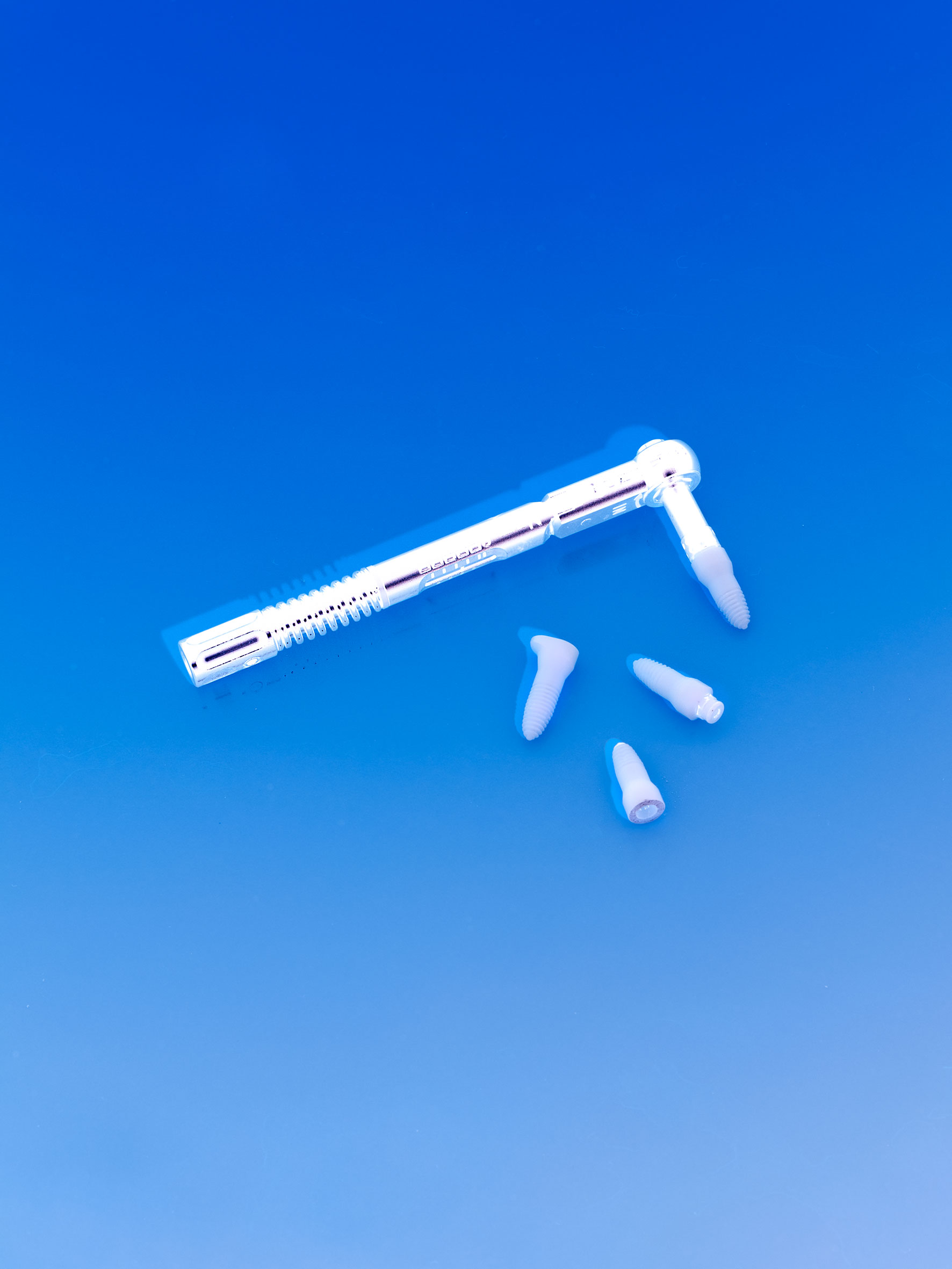
Ceramic implants in Munich:
Biohealth Munich – Centre for integrative-biological dentistry on Marienplatz.
Book your personal appointment today.
A tooth replacement that fits the body
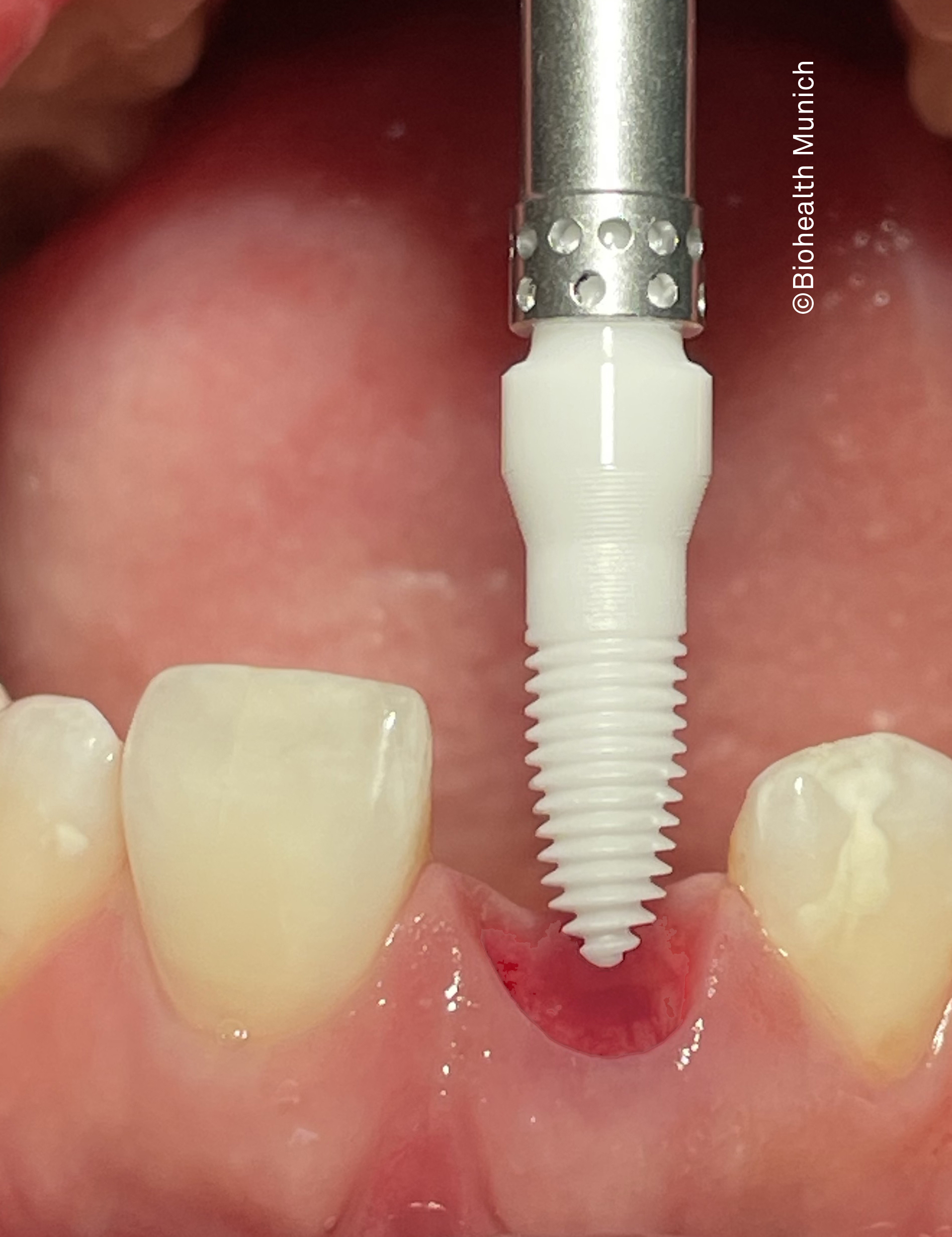
A ceramic implant is a metal-free dental implant and replaces a tooth root. It is made of zirconia — a high-strength white ceramic that has been used in dentistry for years for crowns, bridges and implants.
What matters is how this material behaves once it stays in the body permanently. Zirconia is bioinert. That means it releases no metal ions into the surrounding tissue, it does not change chemically, and it conducts no electrical current. For the body it is a very quiet material — it gives it no reason to react.
Gum tissue takes to this surface well and attaches closely to it. And because the ceramic is white all the way through — not just on the surface — nothing dark shows through. Not even where the gum is thin.
We work exclusively metal-free in Munich. Not as a matter of principle, but because it follows the logic of our concept: as few stimuli as possible for an immune system that has to work for a lifetime.
An implant is not a repair you tick off. It stays in the body for decades. We treat it accordingly.
What speaks for a ceramic implant
1. Well tolerated immunologically
Zirconia is chemically stable and does not bond with the surrounding tissue. In the tissue around zirconia, studies find little of the signalling that the body uses to start an inflammation. For the immune system, that means little reason to stay permanently active.
2. Natural aesthetics
The ceramic is white — just like a natural tooth. There is no dark core that could show through the gums. The gums remain pink, even if they are thin and even if a lot of them are visible when you smile. Especially at the front of the mouth, this is the difference between a result that looks natural and one that stands out.
3. Close gum attachment
Gum tissue attaches particularly tightly to the smooth ceramic surface. That seal is more than a cosmetic detail: it is the first barrier against bacteria, and it protects the bone underneath.
4. Electrically neutral
Zirconia is a non-conductor. It does not produce the galvanic currents that can occur between different metals in the mouth.
5. Often possible in a single session
Where the starting situation allows, we place the implant directly after the tooth is removed. One procedure instead of two, one healing phase instead of two — and often a white tooth to go home with the same day.
6. Durable and fracture-resistant
Ceramic once had a reputation for being brittle. That no longer applies to today’s materials. A ceramic implant is designed for the forces that actually occur when chewing — including at the back of the mouth, where pressure is greatest. It carries a crown permanently without changing.
Just as important is what does not happen over the years: the ceramic does not corrode, it does not discolour, and its surface stays smooth. The gum encounters the same conditions year after year. This is why a ceramic implant still looks the way it did at the start after ten years — and that is the real benchmark. Healing is equally reliable today: studies on immediately loaded ceramic implants show very high survival rates.
OSTEOIMMUNOLOGY
Bone and immune system are one system
Osteoimmunology is still a young field. It describes something medicine treated separately for a long time: bone and the immune system are not side by side, they are interlocked. Bone cells and immune cells sit in the same tissue, they use the same signalling molecules, and they respond to each other.
For an implant, this has an immediate consequence. Whether it integrates and stays stable for decades is not decided by the implant alone, nor by its position alone. It is decided by the immunological condition of the bone it is placed into.
Bone with a silent inflammation running in it for years is a different foundation from healthy bone — even when it causes no pain. On an X-ray, the two can look alike.
This is exactly why our sequence differs from the usual one. We assess the bone first. Only then do we talk about the implant.
This is not the standard in implantology. For us it is not negotiable.
DIAGNOSTICS
We look at the bone first
Diagnostics come first with us — not a treatment proposal.
Where the question of bone quality arises, we measure the density of your jawbone by ultrasound with a device called CaviTAU — through the gum, without X-rays, in a few minutes. On screen you see the result in red and green: where the bone is solid and where it is noticeably soft. Such soft areas are discussed as a possible source of silent inflammation.
We add a three-dimensional X-ray for spatial planning and, where it makes sense, a blood test that shows how active your immune system currently is.
Only once we know what environment we are placing an implant into do we decide on the procedure. Sometimes that means treating the area first and giving the bone time. That takes patience — and it is the single most important factor for a result that lasts decades.
For many patients, this is the most striking moment of the first consultation. They see their own jaw for the first time.
IMMUNOLOGICAL FIREWALL
Where gum and implant meet, most of it is decided
he long-term success of an implant is decided at a place you cannot see: the narrow junction where the gum meets the implant surface.
Where that junction is loose, bacteria and their breakdown products travel downwards — to the bone and beyond it into the body. Specialists call this seepage bacterial leakage.
Gum tissue attaches particularly tightly to zirconia. It then works like a firewall: it reduces the seepage and creates more stable conditions around the implant. We have described this principle in a scientific paper of our own.
For the firewall to work, it needs a sufficiently broad collar of firm, resilient gum — not the thin, mobile lining next to it. Where that collar is missing, we build it. The right material and stable gum together: for us, that is why a ceramic restoration is the more durable solution.
NATURAL AESTHETICS
Aesthetics come out of health
A beautiful result on the day the crown goes in is one thing. The real question is how it looks in five or ten years.
What decides the lasting impression is not the crown. It is the gum. If it stays calm and holds its shape, the result stays beautiful. If it recedes, the finest ceramic no longer helps.
Where the gum is too thin, we reinforce it, using tissue from your own mouth supported by a concentrate made from your own blood. At the front of the mouth, this step decides whether a result looks natural or looks made.
So aesthetics is not an addition for us. It is a by-product of biologically healthy conditions.

REGENERATION
After surgery, the more important part begins
After an operation, the real work is done by the body. Our task is to create the best possible conditions for it.
That is why we developed the Biohealth Munich Bone Healing Protocol — a structured approach to supporting the body’s own regeneration, matched to the procedure, the starting situation and the person.
- PRF — a concentrate made from your own blood. It delivers your body’s growth factors exactly where the healing happens.
- Ozone, to lower the number of microbes in the surgical site
- Infusions, individually composed, to support healing
- Micronutrients and nutrition, used deliberately — so your body has the material it builds bone and connective tissue from
- Light-based treatment and further regenerative measures where they make sense
We check more than how it looks and whether it hurts. Months later, ultrasound lets us measure how the bone in the treated area has actually developed. Hardly anyone does this — and it is the only way to show regeneration rather than claim it.
LONGEVITY
The mouth is not an isolated organ
The mouth is in constant contact with the rest of the body — through the immune system, through nerve pathways, and through the bacteria that live there. Long-running inflammation, including the kind that causes no pain, can influence how the immune system is regulated throughout the body.
Anyone thinking in decades therefore thinks about the mouth as well. Every restoration that stays in the body permanently is a decision with long-term consequences. Not only for the jaw.
This is precisely the difference between fitting an implant and practising integrative-biological dentistry. We do not only ask whether an implant will hold. We ask what it does to the immune system over the years.
Longevity starts in the mouth.

TREATMENT PROCESS
Treatment Process — Biohealth Munich
1. Initial consultation and diagnosis
A thorough discussion of your medical history, a three-dimensional X-ray, and, where indicated, radiation-free ultrasound measurement. You review your findings together with us on screen.
2. Your treatment and cost plan
Following your initial consultation, you receive a written treatment plan with transparent cost breakdown. This gives you time to review everything calmly — without deciding in the treatment chair.
3. Preparation
Our Biohealth Munich Bone Healing Protocol begins weeks before the procedure. Optimal preparation with micro- and macronutrients — among other things Vitamin D3 in combination with Vitamin K2, as well as an adequate supply of amino acids around the time of surgery — is essential to bring bone metabolism into the best possible state by the time of the procedure. This creates the foundation for optimal regeneration afterward. Which measures make sense for you individually, we’re happy to explain during your planning session.
4. The procedure
As tissue-sparing as possible, in many cases performed directly after tooth extraction. We frequently place a white tooth as a bridge on the same day.
5. Regeneration
Support following the Bone Healing Protocol — including photobiomodulation (light therapy) to ease postoperative discomfort, magnetic field therapy, as well as accompanying infusion therapy. Stability check after approximately six weeks.
6. Your finished tooth
The definitive crown, once healing is complete. After that, we continue to support you with aftercare.
IMMEDIATE PLACEMENT
Immediate placement: one procedure instead of two
With immediate implantation we place the metal-free implant directly into the open socket after the tooth has been removed — in the same session. This is an established procedure with clear requirements, set out in the professional guidelines.
The advantage is not only the session saved. The jawbone is stabilised straight away and resorbs less. The gum keeps its shape. And in many cases, later bone augmentation becomes unnecessary.
Whether immediate placement is an option depends on how firmly the implant sits straight away and on the quality of the bone. Not every case is suitable — and we make that assessment after the diagnostics, not before.
INTERNATIONAL PATIENTS
Patients from Europe and around the world
Some of our patients travel to us. From Germany, from across Europe, from North America, the Middle East and Asia. The reason is rarely the implant itself. It is the diagnostics beforehand and the support afterwards.
For patients travelling in, we arrange treatment to fit into as few stays as possible:
- A video consultation before you travel
- Diagnostics and planning bundled into one appointment
- Surgery and temporary crown in a single stay, where this is medically sound
- Follow-up coordinated with your dentist or physician at home
- Consultation and treatment in German and English
Our practice is in the centre of Munich, directly at Marienplatz and the Viktualienmarkt. The airport is around 45 minutes away by train.
PREREQUISITES
What a ceramic implant requires
We think it is right to name the requirements as well. A text that lists only advantages does not help anyone decide.
- A ceramic implant needs healthy bone. Without that foundation, no material holds an advantage — which is why diagnostics come first with us.
- Inflammation around an implant is possible with any material. The close attachment of gum tissue to ceramic creates more favourable conditions — it is not an exclusion.
- How long an implant lasts also depends on you: oral hygiene, nutrition, smoking, the state of your bone metabolism, and the starting situation at the time of placement.
- Integration can never be guaranteed. It depends on factors we can influence but not determine.
What we can promise is thorough diagnosis beforehand and high-quality aftercare.
A specialist practice for ceramic implants
Biohealth Munich is a specialist practice for ceramic implantology. Each year we place between 600 and 700 ceramic implants. Dr Fabian Schick and Dr Florian Notter are both specialists in biological dentistry and ceramic implants; Dr Schick is also SDS Ambassador Europe.
Publications
- Immediate implantation with ceramic implants & connective tissue grafting
View - Building up immunological defences
display - Osseointegration and osteoimmunology in implantology: assessment of the immune sustainability of dental implants using advanced sonographic diagnostics: research and case reports
View - Integrative oral medicine meets aesthetic dentistry: Mission possible
View - Titanium implants and silent inflammation in the jawbone—a critical interplay between dissolved titanium particles and the cytokines TNF-α and RANTES/CCL5 on overall health?
View - Is there immune tolerance to titanium implants?
Show - Free mucosal grafting (FMG) as a long-term strategy
Show - Immediately loaded ceramic implants: A short- and long-term follow-up study
View
Frequently Asked Questions
That depends on your starting situation, the scope of diagnostics, and the accompanying measures required. In the first consultation we establish the findings and discuss the options. You then receive the full treatment plan with a transparent breakdown of costs in writing afterwards — calmly, and with no pressure to decide. Financing options are available through our billing partner DZR.
The field that describes how bone and the immune system work together. For implants it means this: what decides whether an implant lasts is not only how much bone there is, but also whether a silent inflammation is running inside it. Which is why we check that before we place one.
Zirconia is bioinert and releases no metal ions. If an intolerance to a material is known in your case, a metal-free restoration is therefore often the obvious choice. Where an intolerance has been confirmed by testing, the use of metal-free implants is explicitly provided for under the current S3 guideline — the highest quality tier of medical guidelines in Germany.
Usually three to four months, in particular cases up to six. We check stability after around six weeks. Bone healing can be reviewed by ultrasound after around nine months.
Scientific reviews report high survival rates for ceramic implants. The old reputation of ceramic being prone to fracture dates back to the early days of the material – composition and design are different today. Durability also depends on the condition of the bone the implant is placed in. That is precisely why diagnostics come first with us.
The procedure is carried out under local anaesthetic and is painless. We work as tissue-sparing as possible, which keeps the strain low, and we actively support healing afterwards. Many patients find the course of it calmer than they expected.
Yes, that is possible. Diagnostics always come first: we assess the condition of the bone in the affected area and decide on the approach from there. In some cases replacement in the same session is possible; in others, a healing phase makes more sense.
That depends on your policy and insurance status. Some services are reimbursed, others are borne by the patient. Our treatment decisions follow medical necessity, not reimbursement guidelines. For privately insured patients, we provide guideline-based documentation to support your claim.
We treat patients from Europe and around the world. What sets us apart is not the implant, but the sequence: diagnostics before surgery, regeneration after surgery. Our practice is located directly at Marienplatz, around 45 minutes from the airport by train.
Media library
We understand how it connects.
If you want to know whether a ceramic implant is right for your situation, that starts with a diagnosis. Not with a quote.
In the first consultation we take time for your history, carry out the necessary diagnostics, and show you what we see. What follows from that, we discuss together. You receive your treatment and cost plan in writing afterwards.
OUR DIVISIONS